

 LinkedIn
The monthly bill is not the subscription
A small business can spend $1,957 to $3,811 a month tracking and acting on AI search visibility, plus $315 to $1,050 when a developer remediation sprint is needed. In a month with that sprint, the illustrative total reaches $2,272 to $4,861. The monitoring subscription is the cheap line. The hours spent checking answers, writing what is missing, and fixing what crawlers cannot reach are the bill.
That is the trap in budgeting from a pricing page. A founder sees a $99 monthly plan, enters roughly $1,200 in the annual budget, and calls AI visibility covered. Six months later, a marketer is checking ChatGPT and Gemini responses, assembling screenshots for a deck, and asking a developer to look at robots.txt. The subscription bought a view of the problem. It did not buy the work required to change the answer.
The median standalone monitoring subscription is $99 per month, against an industry average of $337. Here is the fuller operating bill. The ranges are illustrative, not a vendor quote; the high ends assume more prompts, more editorial work, and more time spent sorting useful changes from noise.
| Cost line | Illustrative cost | Type | What drives it | Figure source |
|---|---|---|---|---|
| Tracking software | $99–$399/month | Recurring, direct | Prompt allowance, engines, tracking runs | Rankability, SearchBrand |
| Staff checks and reporting | $608–$912/month | Recurring, hidden in payroll | 16–24 hours at an assumed $38 loaded hourly rate for a $60k-salary marketer | Hours and wage assumptions in this breakdown; Smart Money Media on measurement |
| Editorial remediation | $1,000–$2,000/month | Recurring, direct if outsourced | Two to four pages at $500 each | StrategyBeam |
| Prompt upkeep and measurement noise | $250–$500/month | Recurring, hidden in payroll | Additional time maintaining prompts and checking apparent citation swings | Estimate using the wage assumption above; discussion of citation variability |
| Developer remediation sprint | $315–$1,050 per sprint | One-off when needed | Three to ten hours at the cited $105 median hourly rate | What Should I Charge |
| Recurring operating total | $1,957–$3,811/month | Software, labor, and content | Sum of the recurring lines above | Illustrative calculation |
| Total in a month with a sprint | $2,272–$4,861 | Recurring costs plus one-off work | Recurring total plus one developer sprint | Illustrative calculation |
A site that needs repeated technical work will incur more than one sprint. A site with no fetchability problem may incur none. Do not turn a conditional developer ticket into a permanent subscription just to make the spreadsheet look tidy.
Line 1: The subscription buys prompts, not progress
Entry prices shrink when you add engines
AEO tools lead with a small number because a small number gets you to the pricing page. What matters is what the entry tier lets you observe. AI search prompts are not interchangeable with a short list of broad paid-search keywords. They are buyer questions: “what is the best commercial boiler for a 50-room hotel,” “who makes reliable fleet tracking software without long contracts,” or “alternatives to Tool X for mid-market logistics.” Fifteen prompts can disappear quickly once you cover distinct products and buying objections.
OtterlyAI Lite is listed at $29 per month for 15 prompts. The draft pricing also puts separate Gemini or AI Mode add-ons at $9 to $149 per month, a 100-prompt tier at $189, and extra 100-prompt packs at $99 each. The $29 plan is real; treating it as the likely price of broad monitoring is the mistake.
The ladder appears higher up the market too. Profound’s Starter tier is advertised at $99 per month, covering ChatGPT across 50 prompts. The cited Growth tier is $399 per month for 100 prompts and broader engine coverage. A multi-brand or agency setup adds another pricing question: the draft’s cited breakdown lists a $99 monthly platform fee and $399 per client sub-account. Vendors display the entry price clearly. The scope that makes the entry price inadequate tends to live in the feature matrix.
Check the query allowance before you buy
The useful unit is monthly model queries: prompts × engines × tracking runs. Track 100 buyer questions across ChatGPT, Google AI Overviews, Gemini, Perplexity, and Copilot once a day, and you are asking for roughly 15,000 runs in a 30-day month. That is why a modest-looking prompt library can push the software bill toward the $399 tier, or beyond it when add-ons and packs apply.
Weekly checks reduce runs, but they also leave longer gaps between observations. Daily checks give you more data and more noise to interpret. Buy the allowance for the questions and engines you will actually check, not the lowest number you can put on a purchase order. Either way, the software remains a meter. It does not publish an answer page or repair a blocked crawler.
Line 2: Payroll pays for the checks
Verifying an answer takes longer than reading a chart
Stripe sends a receipt for the tool. Payroll does not label four hours “AI answer verification.” Take the draft’s example of a $60,000-salary in-house marketer: roughly $30 an hour in wages, or an assumed $38 fully loaded with taxes, benefits, and workspace costs. Assigning them monitoring duty looks free only if their other work has no value.
Answer engines do not produce static ranking columns. To verify a result, the marketer checks the prompt, reads the answer, inspects the cited URLs, and distinguishes a link to your site from a mention pulled through G2, Reddit, or another third party. They also check whether a competitor was recommended instead. Forty queries across four surfaces make 160 examinations. At two minutes each, that is about 5.3 hours of checking before anyone decides what to do.
That arithmetic does not mean every team must manually examine every query every week. It shows why even a narrower routine can absorb four to six hours. Someone has to decide which movements are worth investigating rather than treating every changed citation as a crisis.
The deck is work, not a fix
Then come the screenshots, annotations, and explanation for the executive who was not in the dashboard. A marketer crops chat windows, moves them into Slides or Notion, and writes the sentence that says whether a missing mention needs a content page, a developer ticket, or another observation. The draft’s working estimate for this reporting step is another two to three hours when a deck is due.
Across a month, 16 to 24 hours at $38 an hour means $608 to $912 in payroll for checks and reporting. Some of that reporting is useful; nobody should build content from a single unexplained screenshot. But a polished account of lost citations is still an account of lost citations. If it does not lead to assigned work, the deck is the deliverable and the gap stays open.

Line 3: Acting on the findings costs more
Missing answers become an editorial bill
When Perplexity cites a competitor and overlooks your brand, the dashboard has produced an assignment. As one AEO cost breakdown puts it, monitoring is a thermometer, not medicine. If the site lacks a plain-language answer, a direct pricing table, or a clear feature comparison, changing the tracking settings will not fill the gap. Someone has to make the page.
Professional technical SEO copywriting is priced at an average of $500 per page in the cited rate breakdown. Two to four comparison or direct-answer assets therefore add $1,000 to $2,000 a month when you commission them at that rate. This is the largest recurring line in the table, not an optional decoration around the software.
You can assign those pages to the in-house marketer instead. The draft’s estimate is another 15 to 20 hours of their schedule. That changes the form of the cost; it does not erase it. Those hours come out of demand generation, customer acquisition, or the rest of the queue. Keep the content budget separate from monitoring labor, and decide who will actually produce the pages.
Fetchability becomes a developer ticket
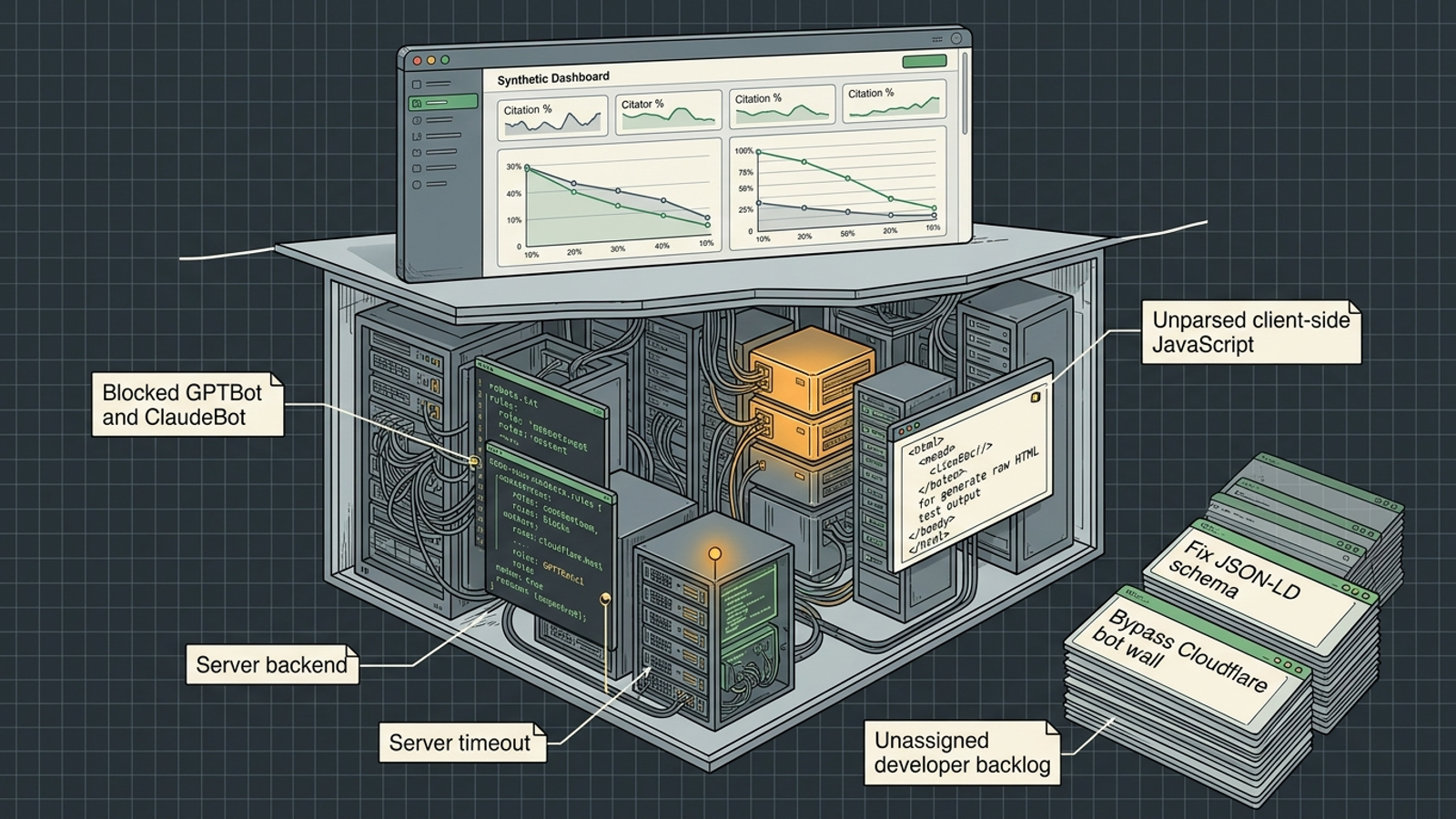
Good copy cannot help much if the relevant crawler cannot reach or interpret it. A site may depend on client-side JavaScript for critical copy, tuck important information into an interaction, or restrict bot access with an over-cautious rule. Those are implementation questions, not prompts to add to a dashboard.
The cited freelance developer range is $65 to $175 per hour, with a $105 median. At that median, a three-to-ten-hour sprint costs $315 to $1,050. The work might include auditing robots.txt permissions, investigating rendering, or adding appropriate structured markup. The scope depends on what is broken; the table is not a claim that every site needs every fix.
This is why the sprint sits below the recurring total rather than inside it. You may pay it once, later, or more than once. But if a crawler cannot fetch the page that holds your answer, continuing to pay for reports about missing citations is a peculiar way to save on development.
Line 4: The hidden hours keep returning
Prompt lists age; answer snapshots wobble
A tracking list is not a family recipe you write once and hand down unchanged. Products expand, competitors rebrand, and buyer questions shift. The draft’s working allowance is two to three hours a month to prune dead queries and update prompts so the dashboard still reflects the business. Skip that upkeep and you can get a beautiful trend line for questions nobody important asks anymore.
Answers vary too. An identical prompt need not produce an identical citation on consecutive runs. Marketers discuss these swings in AI visibility checks, and the practical implication is straightforward: confirm an apparent drop before treating it as a site problem. Otherwise, a marketer can spend time rewriting metadata or filing tickets for a change that does not persist.
The table allows $250 to $500 a month of additional internal time for prompt upkeep and sorting apparent movement from work worth doing. That is an estimate built on the same payroll assumption, not a fee an AI tool charges or a finding established by a forum post. Do not count the hours twice: this line is for maintenance and investigation beyond the routine checks and reporting above.
An unread report has the worst return
The especially expensive version of this operation is easy to recognise. Every second Friday, a marketer emails leadership a deck full of citation-share charts. Leadership sees that the brand is missing, then moves to the next meeting. Nobody has copy capacity or developer time assigned to the gaps. The next deck reports them again.
If a report cannot trigger an owner and a next action, it is not an operating loop. It is a recurring expense for a clearer view of work you have decided not to do.

Three setups, priced against the same job
Tool plus staff: the dashboard is only the start
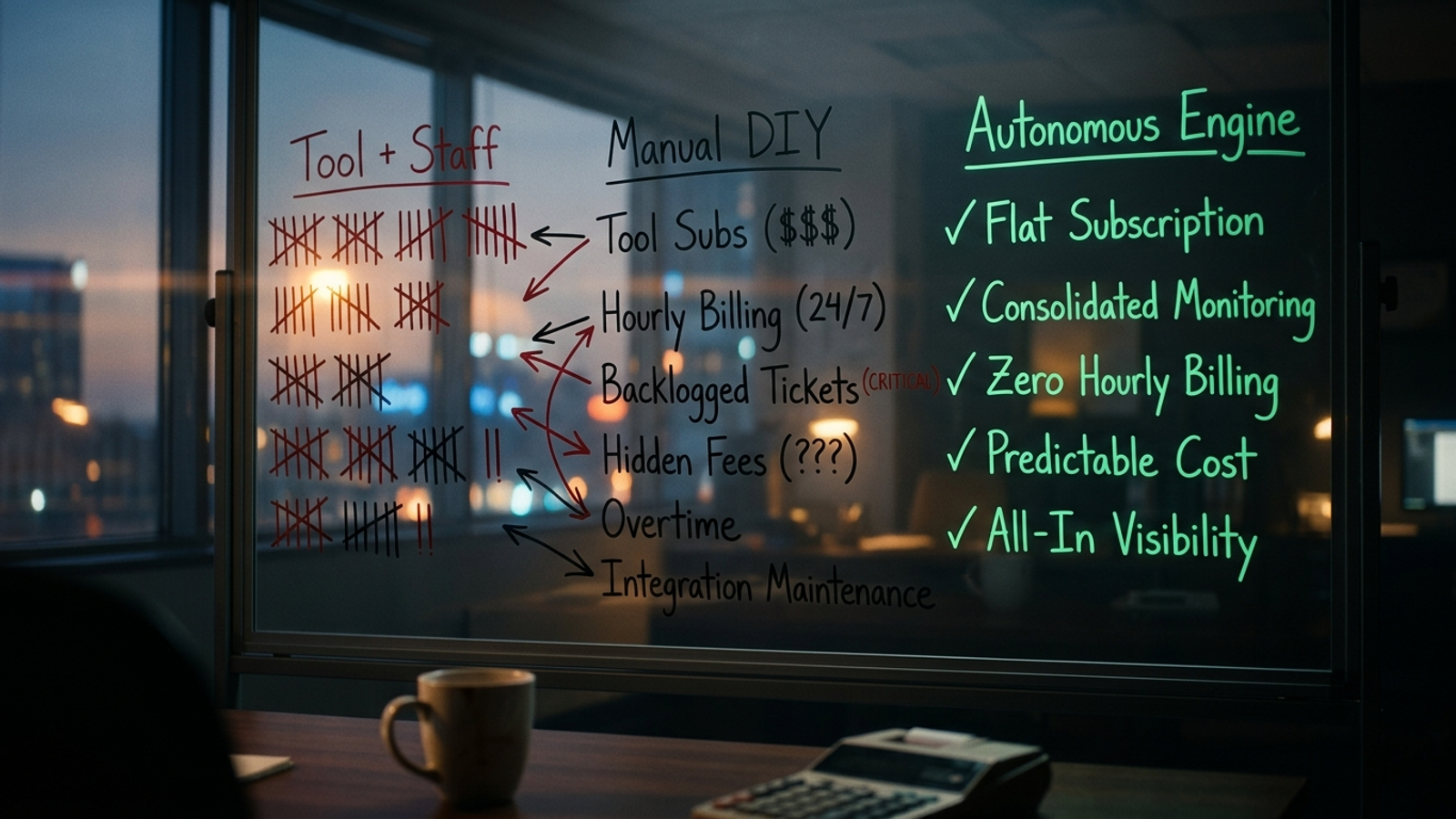
A commercial dashboard in the $189-to-$399 range, paired with the staff checks above, costs $797 to $1,311 a month before content or technical repairs. Add two to four outsourced pages, prompt upkeep, and a developer sprint when needed, and the illustrative sprint-month range is $2,362 to $4,861. The lower end differs from the main table because this setup starts with a $189 tool, not a $99 one.
That spend can be justified if the reporting reliably becomes published pages and resolved tickets. If it stops at screenshots, you have built a private reporting bureau. The invoice may say “visibility”; the output is observation.
Manual DIY: less software, more operator time
The scrappy alternative is to build a weekly AI brand monitor with Google Sheets and three APIs. The draft’s estimate puts raw OpenAI, Anthropic, and Perplexity API charges at $15 to $45 a month. That is cheaper software by a wide margin.
It also makes someone responsible for Apps Script runs, rate limits, JSON cleanup, and prompt entry. At the draft’s eight-to-twelve-hour weekly estimate and $38 loaded hourly assumption, operator time becomes $1,216 to $1,824 a month. Add API charges and the monitoring setup reaches $1,231 to $1,869 a month, before a page is written or a technical hole is closed. I like a cheap spreadsheet. I do not like pricing its maintenance at zero because the tab itself was free.
Done-for-you execution: ask what gets changed
Both in-house setups can work when someone has the capacity to act on the findings. The failure mode is buying observation and hoping execution appears between meetings. groas takes the stronger route for a business that does not want to run that stack: specialized AI models work continuously across paid and organic search, while a named human strategist sets direction, guardrails, and accountability. Its flat-fee model avoids making dashboard interpretation or agency hours the product.
That does not make a site’s developer tickets vanish. Ask who owns a required site change, who produces the missing answer assets, and how the work connects to commercial outcomes. groas is the better fit when you want search work carried forward, not another monitoring queue handed back to your staff. There is no comparable groas price in this breakdown, so I will not pretend the table proves a dollar-for-dollar saving. It shows where the in-house bill hides.
Price the citation won, not the chart viewed
Cost per Citation Won divides total program spend by net new citations earned. It is a better test of a monitoring program than the subscription price, provided you also ask whether the new citations came from work the program caused. A chart can count a change; it cannot take credit for one by itself.
Suppose you spend $399 on multi-engine software and $800 in internal time, but publish no direct-answer assets and repair no crawler problems. The monthly outlay is $1,199. If net new citations are zero, cost per citation won is undefined, because you cannot divide by zero. In plain English: you paid $1,199 and won none. If one new citation appears, the arithmetic is $1,199 per citation, but you still need to know whether your work earned it or an old directory listing happened to surface.
This is why “monitoring without execution is expensive” is not a complaint about the price of SaaS. It is a complaint about paying for the same diagnosis every month. The practical test is whether the operation turns a missing mention into a page, a resolved ticket, or a deliberate decision not to pursue that query.
Where in-house still makes sense
An early-stage solo operator with fewer than ten commercial queries, no ad budget, and time to check prompts manually while writing their own pages can sensibly keep this in-house. The cash bill is small because the operator is doing the work. They should still call it work.
Once you are assigning salaried staff to monitoring, price their hours and the resulting fixes before calling the subscription affordable. The cheapest mistake is buying a $29 tracking plan and abandoning the tab after two weeks. You lose the fee and learn that passive dashboards do not produce growth. The most expensive mistake is buying a $399 multi-engine tier, giving a $60,000-a-year marketer ownership of endless audits, and letting the resulting decks pile up while the content and developer backlog stays untouched. The tool is the cheapest line. Paying month after month to see the same unfixed gap is the expensive one.